
Why Your Denver Home Gets Dustier Than Any Place You've Ever Lived

Denver's dry, high-altitude air makes dust a relentless problem for local homeowners. Here's the science behind why — and what actually helps.
You unpacked your things. You cleaned. You wiped everything down. And then, a week later, you ran your finger across the bookshelf and found a thin gray film that definitely wasn't there before.
If you moved to Denver from pretty much anywhere else in the country, this moment is practically a rite of passage. The dust here isn't your imagination — and it's not that you're a bad housekeeper. Denver has a legitimate, geography-driven dust problem, and once you understand why, the whole thing starts to make a lot more sense.
It Starts with the Air (or Rather, What Isn't in It)
Denver sits at 5,280 feet above sea level. At that altitude, the air is thinner and holds significantly less moisture than it does at sea level. That dryness is what gives Denver its famous 300-plus sunny days a year, and it's also what makes dust such a persistent houseguest.
Here's what most people don't realize: moisture is actually one of nature's best dust suppressants. In humid climates, airborne particles absorb water, get heavier, and fall out of the air quickly — often before they ever settle on your surfaces. In Denver, those same particles stay light and airborne far longer. They drift, circulate, and eventually land on everything.
The Rocky Mountains add another layer to this. They create a natural barrier that blocks moisture-carrying air systems from reaching the Front Range. The result is that Denver gets very little rainfall compared to cities at similar latitudes, and what little humidity exists gets baked off quickly by that intense Colorado sun.
All of this means your home isn't just sitting in dry air — it's actively losing moisture to it. And the drier your indoor air, the more freely dust moves around.
Why Denver Dust Hits Harder in Winter
You might expect summer to be worse, given the outdoor activity and open windows. But many Denver homeowners notice dust really piles up in winter — and there's a reason for that.
When temperatures drop and you fire up the furnace, a few things happen at once. Your home seals up tight. The heating system starts circulating air constantly. And indoor humidity levels — already low by nature — drop even further as the dry air gets heated and pushed through your vents.
Forced-air heating is essentially a dust-distribution system. Whatever has settled in your ductwork, on your vents, and in your filters gets kicked back into the air and redeposited throughout your home. If you've noticed a dusty smell right when the heat kicks on for the first time in fall, that's exactly what you're smelling.
Where Denver Dust Loves to Hide in Your Home
Knowing where to look helps a lot. Dust in a dry climate behaves differently than dust in humid areas — it's finer, lighter, and gets into spots that feel counterintuitive.
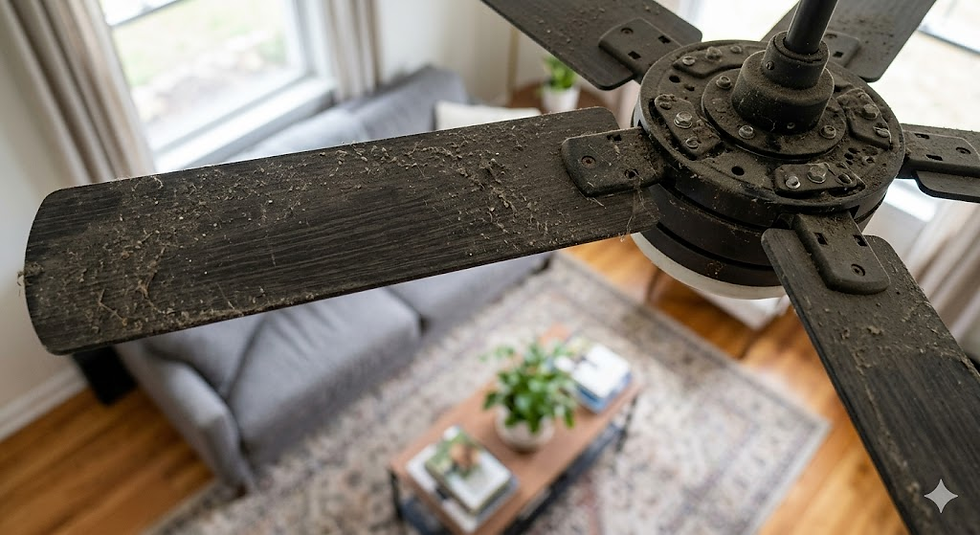
Ceiling fans are one of the worst offenders. They sit out of your sightline, and in Denver's dry air, they attract a thick layer fast. When they spin, they scatter that dust right back down onto everything below.
Window blinds and sills get hit hard by Denver's intense sun — every particle gets highlighted, and the static created by the dryness pulls dust toward the slats like a magnet.
Electronics — TVs, computers, gaming consoles — generate static that makes them dust magnets everywhere, but in a dry climate that static is amplified significantly.
Upholstery and area rugs act like filters, trapping fine particulate deep in their fibers. In Denver's dry, dusty environment, rugs accumulate debris faster than most homeowners expect, and standard vacuuming often can't pull it all back out.
Air vents and returns are often the most overlooked. Your HVAC system is constantly pulling air in and pushing air out — and in Denver, that air carries a lot of fine particles with it.
The Wildfire Factor
Starting around July and running into fall, wildfires in the Rockies and across the western states push smoke and fine particulate matter into the Denver metro. During bad years, you can smell it and see it in the sky — but even on days when the air looks okay, fine particles are infiltrating your home through gaps around windows, doors, and HVAC systems.
That smoke particulate is some of the finest, most clingy material that can settle in a home. It gets into fabric, coats hard surfaces with a subtle film, and can linger long after the air outside has cleared. If your home feels extra grimy in late summer or early fall, wildfire smoke is often part of the explanation.
What Actually Helps
The good news is that once you understand what you're dealing with, you can fight it more effectively. A few things make a meaningful difference in a Denver home specifically:
A quality air purifier with a HEPA filter is worth the investment here in a way it might not be in a more humid climate. It actively removes particles from the air before they settle. Run it consistently, not just when things look bad.
Microfiber cloths over feather dusters — feather dusters just relocate dust in Denver's dry air. Microfiber actually traps it.
Humidity management helps more than most people expect. Keeping indoor humidity between 35% and 50% — the recommended range for Colorado homes — makes dust particles heavier and less likely to stay airborne. A whole-home humidifier connected to your HVAC system is the most effective option; portable units can help in individual rooms.
More frequent filter changes than you think you need. The recommendation of every 90 days is for average conditions. Denver isn't average. Check your filter monthly; change it every 30 to 60 days during heating season.
Professional cleaning on a regular schedule makes a measurable difference in homes here because of how quickly buildup accumulates. The areas that are easiest to overlook — ceiling fans, vents, baseboards, blinds — are exactly where Denver's dust concentrates the most.
The Bottom Line
Denver's dust problem is real, it's science-backed, and it's not going away. The altitude, the dry air, the lack of rainfall, the furnace winters, and the wildfire summers all add up to an environment where staying on top of indoor cleanliness takes more effort than it would in most cities.
The homeowners who adjust their expectations and their cleaning habits tend to feel a lot better about it — not because it becomes easy, but because they stop blaming themselves and start addressing the actual cause.
If you'd like some help keeping up with it, we offer recurring cleaning services across Denver and surrounding areas — from Downtown and all the way to Castle Rock, Arvada, Broomfield, and beyond. Get in touch to schedule your first clean → https://www.introductioncleaning.com/
Tags: Denver home cleaning, Denver dust, cleaning tips Denver, high altitude cleaning, dry climate home care

Comments